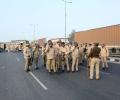
Truck drivers protesting against a provision in the new penal law on hit-and-run road accidents, called off their strike in Nashik district of Maharashtra on Tuesday after the local authorities assured to look into their demands.
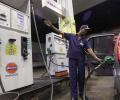
Petrol price in Delhi was hiked to Rs 77.28 per litre from Rs 76.73, while diesel rates were increased to Rs 75.79 a litre from Rs 75.19, according to a price notification from State oil marketing companies. Rates have been increased across the country and vary from state to state depending on the incidence of local sales tax or VAT.
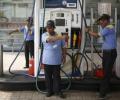
In nine hikes, petrol price has gone up by Rs 5 per litre and diesel by Rs 4.87 a litre.
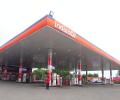
Indian Oil Corporation (IOC) on Tuesday reported halving of its March quarter net profit largely because of losses in the petrochemical business and shrinking margin after it announced a pre-election fuel price cut despite rising input costs. The net profit of Rs 4,837.69 crore in January-March compared to Rs 10,058.69 crore a year back and Rs 8,063.39 crore in the preceding October-December quarter, according to a stock exchange filing by the company.
However, copious oil supplies amid growing global output and slowing Chinese oil consumption will put India in a better bargaining position with Gulf suppliers.

Five out of the top 10 companies in Fortune 500 list of Indian companies are from the oil sector.

India may have to lean more on West Asian nations for supplies of liquefied petroleum gas (LPG), a cooking fuel, in the coming years after Indian state-run refiners drew up big plans to diversify into producing more profitable petrochemicals. This shift leads to reduced LPG output, Indian refining executives said. The mantra for state-run oil companies, from Indian Oil Corporation (IndianOil) to liquefied natural gas (LNG) importer Petronet LNG, which are looking to diversify their businesses from lower-margin fuels, has been value-added petrochemicals.
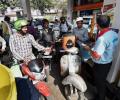
In 13 hikes, petrol price has gone up by Rs 7.11 per litre and diesel by Rs 7.67 a litre.

Russian energy giant Rosneft has appointed a former Indian Oil Corporation (IOC) director to its board in signs it may be looking at boosting trade links with India. G K Satish, who retired as director for business development at IOC in 2021, is one of the three new faces appointed to the 11-strong board of directors of Rosneft, according to a statement issued by the Russian firm. Satish, 62, is the first Indian to be appointed to the board of Rosneft.

Government-owned companies are more generous in rewarding their shareholders with dividends.

Jet fuel or ATF price on Tuesday was hiked by a steep 8.5 per cent - the second increase in a month, while commercial cooking gas rate was cut by Rs 100 per cylinder in line with divergent trends in international benchmarks. Aviation turbine fuel (ATF) price was increased by 7,728.38 per kilolitre, or 8.5 per cent, in the national capital to Rs 98,508.26 per kl, according to a price notification of state-owned fuel retailers. Rates, which vary from state to state depending on the incidence of local sales tax or VAT, have been increased on firming up of global rates that followed four months of decline.

Capital expenditure (capex) by 54 large central public sector enterprises (CPSEs) and five departmental arms with an annual capex target of Rs 100 crore and above has reached around 42.5 per cent of their annual target of about Rs 7.33 trillion in this financial year so far, a senior official from the Ministry of Finance told Business Standard. "The Centre is pushing the big public undertakings in the infrastructure and refinery sector to achieve 90 per cent of their target by the end of the third quarter," he said. The capex by this group of CPSEs stands at around Rs 3.1 trillion in the April-August period so far.

In 12 hikes, petrol price has gone up by Rs 6.55 per litre and diesel by Rs 7.04 a litre.
In all, petrol price has gone up by Rs 1.74 per litre and diesel by Rs 1.78 a litre in three days.

Many residents complained of suspected gas leak from Chembur, Ghatkopar, Powai and Vikhroli areas late on Saturday night, an official of the BMC's disaster management cell said.
Jet fuel or ATF price on Wednesday was cut by almost 6 per cent after four rounds of monthly increases since July, while commercial cooking gas (LPG) rates were raised by a steep Rs 101.5 per 19-kg cylinder in line with international benchmarks. However, the price of domestic LPG - used in household kitchens for cooking purposes - remained unchanged at Rs 903 per 14.2-kg cylinder. Aviation turbine fuel (ATF) price was cut by Rs 6,854.25, or 5.79 per cent, in the national capital to Rs 111,344.92 per kl from Rs 118,199.17, according to a price notification of state-owned fuel retailers.
Indian imports of Russian oil plunged by a record in August month-on-month (M-o-M) as discounts on the fuel shrank in tandem with rising Brent oil prices. Higher crude prices will drive inflation or hurt earnings at oil companies and India's fiscal position if such spikes are not passed on to consumers. Indian purchases of Russian crude declined by around 24 per cent in August from July to the lowest level since January, with refiners expecting volumes to drop further amid rising rates of Russian benchmark Urals grade, substantial stocks at refiners, and planned maintenance at Indian refineries, according to ship tracking data and industry officials.
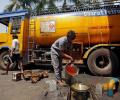
After a spike in crude oil and gas prices in October following the Hamas terror attack, prices eased down 9 per cent month-on-month in November. The Organization of the Petroleum Exporting Countries (Opec) and Opec+ agreed to a further voluntary production cut in January-March 2024 to try and support global crude prices. The best guess here is that crude prices (currently at $75/barrel, or bbl) will not likely cross significantly above $80, and gas prices are also likely to remain subdued unless there's a further escalation in the Israel-Hamas conflict.
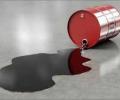
The Oil Ministry has fixed the subsidy payout by upstream firms like Oil and Natural Gas Corporation and Oil India Ltd at Rs 15,546.65 crore (Rs 155.46 billion) for the April-June quarter.
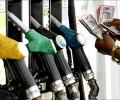
Petrol price cut by 50 paisa a litre; diesel by 46 paisa.

Petrol and diesel prices were hiked by 80 paise a litre each on Saturday, the fourth increase in five days as oil firms passed on to consumers the spike in cost of raw material. Petrol in Delhi will now cost Rs 98.61 per litre as against Rs 97.81 previously while diesel rates have gone up from Rs 89.07 per litre to Rs 89.87, according to a price notification of state fuel retailers. All the four increases since the ending of a four-and-half-month long hiatus in rate revision on March 22, have been of 80 paise a litre.

The government on Thursday permitted 100 per cent foreign investment under the automatic route in oil and gas PSUs which have received in-principle approval for strategic divestment. The move would facilitate privatisation of India's second biggest oil refiner Bharat Petroleum Corp Ltd (BPCL). The government is privatising BPCL and selling its entire 52.98 per cent stake in the company.

'The universe of PSU stocks is huge and diverse.' 'Investors should bet on specific sectors and stocks from the basket as most of them may continue to consolidate after years of outperformance.'
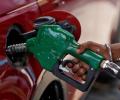
The market responded positively to the Q1 results of oil marketing companies (OMCs), Bharat Petroleum Corporation (BPCL) and Hindustan Petroleum Corporation (HPCL) despite numbers being weaker than consensus. BPCL's reported gross refining margin (GRM) was in line at $7.9 per barrel (bbl) in Q1FY25, which implies marketing margin stood at Rs 4.8 per litre. Standalone profit after tax or PAT at Rs 3,000 crore was down versus consensus due to under-recoveries in LPG business.

The Centre may overshoot the Rs 56,260 crore target for dividend receipts from central public-sector enterprises (CPSEs) set for FY25 and is likely to end up getting around Rs 65,000 crore this financial year, according to a senior government official. This excludes dividend from nationalised banks and financial institutions. As on October 21, the Centre collected Rs 28,913 crore as dividend and other investment from CPSEs, accounting for over 50 per cent of the Budget Estimate for FY25.

All of these companies are present in India.
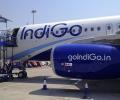
Airfares in the country are set to rise, with IndiGo on Thursday introducing a fuel charge of up to Rs 1,000 based on a flight's distance, in response to the significant rise in aviation turbine fuel (ATF) prices in the last three months. The Indian aviation sector experiences its peak travel season between October and December. The inclusion of a fuel charge component in airfares is anticipated to have a sizable impact on IndiGo's passengers, according to experts.

Share prices of both upstream and downstream public sector oil companies fell up to two per cent on Monday. Even Essar Oil, a private fuel retailer, fell 1.50 per cent on the Bombay Stock Exchange.

BPCL gained nearly 4% to Rs 674, while HPCL gained more than 2% to Rs 451.
Indian Oil Corporation (IOC), Bharat Petroleum and Hindustan Petroleum may post a combined loss of Rs 10,700 crore in June quarter on selling petrol and diesel at rates below cost, a report said on Monday. While the raw material (crude oil) prices soared in April-June, petrol and diesel prices were not revised, leading to marketing losses which offset strong refining margins, ICICI Securities said in the report. The three state-owned oil marketing companies -- IOC, BPCL and HPCL -- control 90 per cent of the retail petrol and diesel sales in the country.
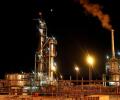
Escalation of the conflict in West Asia between Israel and Iran has had a direct impact on the energy markets, and more broadly on the financial markets as well as the global economy.
If the reforms are implemented, multi-brand retail majors such as Future Group and Reliance Retail might enter the fuel retail space.
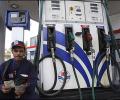
Oil marketing companies on Friday cut petrol price by 32 paise, and diesel by 85 paise a litre with effect from midnight tonight.
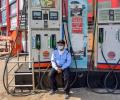
Petrol price on Tuesday breached the Rs 85 a litre mark in the national capital and diesel neared record high after rates were raised for the second consecutive day. Petrol and diesel prices were hiked by 25 paise per litre each, according to a price notification from oil marketing companies. This took the petrol price in Delhi to Rs 85.20 per litre and to Rs 91.80 in Mumbai. Diesel rate climbed to Rs 75.38 a litre in the national capital - just shying away from its record high - and to an all-time high of Rs 82.13 in Mumbai, the price data showed.
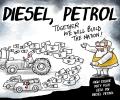
Petrol and diesel price soared to an all-time high across the country on Friday after rates were hiked again by 25 paise and 30 paise a litre, respectively. The price of petrol in Delhi rose it its highest ever level of Rs 101.89 a litre and to Rs 107.95 in Mumbai, according to a price notification of state-owned fuel retailers. Diesel rates too touched a record high of Rs 90.17 in Delhi and Rs 97.84 in Mumbai.
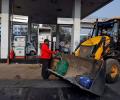
Diesel price on Friday was hiked by 20 paise per litre - the first increase in rates in over two months - as international oil prices neared their highest since 2018. Price of diesel was hiked to Rs 88.82 per litre in Delhi and to Rs 96.41 in Mumbai, according to a price notification of state-owned fuel retailers. Petrol price was not changed. It costs Rs 101.19 a litre in Delhi and Rs 107.26 in Mumbai.
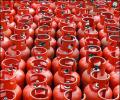
The price of non-subsidised cooking gas (LPG) was on cut by Rs 21 per cylinder and that of jet fuel (ATF) by a steep 3 per cent on the back of falling international oil rates.

Capital expenditure by 54 large central public sector enterprises and five departmental arms, having a capex minimum target of Rs 100 crore, rose 93 per cent year-on-year (YoY) in the April-May period to Rs 1.39 trillion. The National Highways Authority of India (NHAI) and the Railways have started this financial year's capex cycle on a stronger note. In the first two months of FY24, the 54 CPSEs, along with the departmental arms, achieved 19 per cent of their combined budget target of Rs 7.33 trillion, Business Standard has learnt.
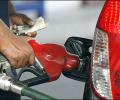
Petrol price was on Monday hiked by Rs 2.19 a litre and diesel by 98 paise per litre.
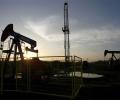
There are about 23 oil refineries in India with a combined capacity of 230 million tonnes per annum.
